Rick Wakeman
Progressive rock keyboardist with Yes
Progressive rock keyboardist with Yes
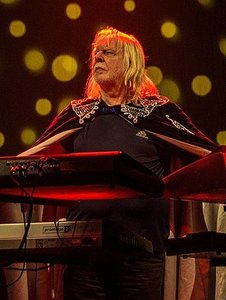
A prominent progressive rock keyboardist and songwriter, contributed significantly to the music scene from the late 1960s onwards. Played with the band Yes, contributing to iconic albums including "Fragile" and "Close to the Edge." Additionally, developed a successful solo career with albums such as "The Six Wives of Henry VIII." An accomplished session musician, collaborated with various artists across different genres. Known for elaborate live performances featuring a wide array of keyboards and visual components.
Played keyboards for Yes on classical albums
Released the solo album 'The Six Wives of Henry VIII'
Worked as a session musician with various artists
A prominent figure in American music and art, contributions span various fields including music, visual arts, and film scoring. Co-founded the band Devo, which gained notoriety in the late 1970s for its unique blend of new wave and punk rock, coupled with its intellectual themes. Mothersbaugh's work with Devo includes classic hits such as 'Whip It'. In addition to music, engaging in visual art practices, he has exhibited his artwork in numerous galleries. Composed scores for films including 'The Lego Movie' and 'Rushmore', establishing a reputation in film music.
Continue ReadingA prominent American photographer and journalist, contributed significantly to the field of photography during the Civil War. Established a studio in New York City and captured some of the earliest and most impactful images of wartime. Influenced the public's perception of the war through compelling portraits of soldiers and battlefield scenes. Innovations in photographic techniques expanded the medium's capabilities, making the photographs significant historical documents. Played a pivotal role in bringing photography into public awareness.
Continue ReadingAn astronomer and physicist focused on high-energy astrophysics. Contributed to the understanding of black holes and cosmic radio sources. Served as a professor at the University of Cambridge and as a director of the Institute of Astronomy. Authored several significant publications and texts on astrophysics, particularly emphasizing the role of black holes in the universe.
Continue ReadingServed as the Gonfaloniere of Florence from 1502 to 1512, overseeing the city's administration and military matters. Implemented reforms aimed at strengthening the republican system during a tumultuous period in Florentine politics. Fostered cultural developments that aligned with the Renaissance ethos, providing support to artists and intellectuals. Engaged in diplomatic efforts, striving to maintain Florence's independence amidst competition with neighboring states and the influence of the Papacy.
Continue ReadingServed as a prince of Rostov during the 12th century and became a bishop later in life. His leadership included the establishment of ecclesiastical and administrative control in the region. The bishopric contributed to the growth of the Orthodox Church in northeastern Rus, fostering religious and cultural development.
Continue ReadingA Nicaraguan rebel leader opposed U.S. military intervention in Nicaragua during the 1920s and 1930s. Founded the Sandinista National Liberation Front, which became a key political force in Nicaragua. Sandino's guerrilla warfare strategies inspired many leftist movements across Latin America. He emphasized national sovereignty and social justice. Assassinated in 1934, his legacy continued to influence Nicaraguan politics and revolutionary movements.
Continue Reading